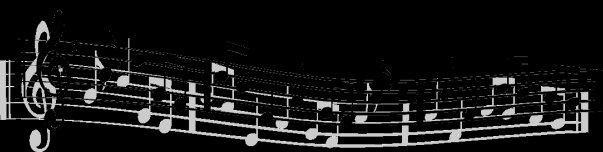
The Underground Train,
Strange as it seems,
Carried many passengers
And never was seen
It wasn’t made of wood,
It wasn’t made of steel;
A man-made train that
Ran without wheels.
The train was known
By many a name.
But the greatest of all
Was “The Freedom Train”
The Quakers, the Indians,
Gentiles and Jews,
Were some of the people
Who made up the crews.
Free Blacks and Christians
And Atheists, too,
Were the rest of the people
Who made up the crews.
Conductors and agents
Led the way at night,
Guiding the train
By the North Star Light.
The passengers were
The fugitive slaves
Running from slavery
And its evil ways.
Running from the whip
And the overseer,
From the slave block
And the Auctioneer.
They didn’t want their masters
To catch them again,
So men dressed as women
And the women dressed as men.
Blockson, Charles L. The Ballad of the Underground Railroad. Retrieved October 24, 2008, from http://blackhistory.owensound.ca/ballad.php
Swing Low Sweet Chariot by Wallis Willis
Chorus:
Swing low, sweet chariot,
Comin' for to carry me home!
I looked over Jordan and what did I see,
Comin' for to carry me home!
A band of angels comin' after me,
Comin' for to carry me home!
Chorus:
If you get there before I do,
Comin' for to carry me home,
Jess tell my friends that I'm acomin' too,
Comin' for to carry me home.
Chorus:
I'm sometimes up and sometimes down,
Comin' for to carry me home,
But still my soul feels heavenly bound
Comin' for to carry me home!
Willis, Wallis. Swing Low Sweet Chariot. Retrieved October 25, 2008, from http://blackhistory.owensound.ca/swinglow.php
To Listen to the Song, Click on the Link Below:
You may find the language of slave poetry confusing. When reading, try to evaluate the main ideas of each poem.
| ||
|
S L A V E R Y,
A P O E M.
IF heaven has into being deign'd to callThy light, O LIBERTY! to shine on all;
Bright intellectual Sun! why does thy ray
To earth distribute only partial day?
Since no resisting cause from spirit flows 5
Thy penetrating essence to opose;
No obstacles by Nature's hand imprest,
Thy subtle and ethereal beams arrest;
Nor motion's laws can speed thy active course,
Nor strong repulsion's pow'rs obstruct thy force; 10
Since there is no convexity in MIND,
Why are thy genial beams to parts confin'd?
Why should fell darkness half the South invest?
Was it decreed, fair Freedom! at thy birth, 15
That thou shou'd'st ne'er irradiate all the earth?
While Britain basks in thy full blaze of light,
Why lies sad Afric quench'd in total night?
Thee only, sober Goddess! I attest,
In smiles chastis'd, and decent graces drest. 20
Not that unlicens'd monster of the crowd,
Whose roar terrific bursts in peals so loud,
Deaf'ning the ear of Peace: fierce Faction's tool;
Of rash Sedition born, and mad Misrule;
Whose stubborn mouth, rejecting Reason's rein, 25
No strength can govern, and no skill restrain;
Whose magic cries the frantic vulgar draw
To spurn at Order, and to outrage Law;
